Choosing the right deep learning server manufacturer can shape a project’s speed, cost, and reliability. A server is not merely a box filled with GPUs. It is the working environment for data pipelines, model training, storage, networking, and future upgrades. A poor match may produce impressive benchmark numbers but frustrating daily operations.
Michael Dell, founder and CEO of Dell Technologies, has described artificial intelligence as “the most important technology of our lifetime.” His view highlights a practical reality: AI infrastructure deserves long-term planning. Buyers should examine GPU compatibility, thermal design, power limits, memory capacity, NVLink or high-speed interconnect support, and service coverage. They should also check whether the manufacturer understands real training workloads, not only laboratory demonstrations.
The best deep learning server manufacturer should provide transparent specifications and evidence from comparable deployments. Ask for benchmark details, including model size, batch size, precision, dataset, and number of GPUs. Look beyond attractive peak performance. A server room with limited cooling may never reach that advertised speed. On-site support, spare parts, firmware updates, and warranty response times matter just as much.
There is no perfect choice.
A smaller manufacturer may offer flexible customization. A global vendor may provide stronger support and supply continuity. Both options have weaknesses. I would also question my own assumptions, especially when a familiar brand feels automatically safer. The final decision should balance measurable performance, operating cost, expansion plans, and the team’s technical experience. This guide explores those factors carefully, so readers can choose a dependable platform rather than simply the most expensive one.
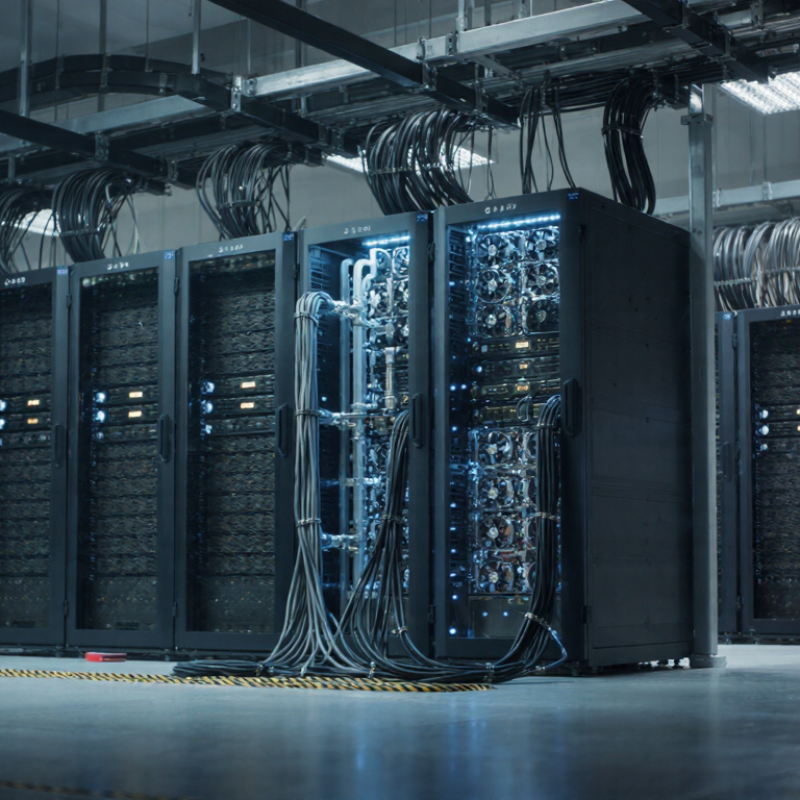
Choosing a deep learning server manufacturer starts with workload definition, not a glossy specification sheet. Map each model by parameter scale, sequence length, data type, and expected batch size. A compact vision model may need one GPU, while a large language model can require eight or more. Record memory use during peak steps, not only average runs. Peak memory matters.
Translate training goals into measurable throughput, such as samples per second or tokens per hour. Then test whether the proposed server can sustain that rate for several hours. Short benchmarks can hide thermal throttling, communication delays, or unstable storage. For multi-GPU workloads, inspect GPU interconnect bandwidth, host memory, PCIe layout, and network latency. These details affect scaling efficiency more than theoretical peak performance. Ask the manufacturer for reproducible test conditions, firmware versions, and power limits.
A dependable manufacturer should explain cooling capacity, redundant power design, service response, and spare-part availability. Request a configuration matched to your model, rather than accepting a generic eight-GPU chassis. It may cost less initially, but poor airflow can reduce useful training time. Leave room for future memory and accelerator changes. That plan is imperfect. Real workloads evolve, and early estimates are often wrong. Review utilization after deployment, compare promised throughput with measured results, and adjust the next purchase accordingly.
| Model Scale | Typical Training Workload | Recommended GPU Count | GPU Memory Requirement | Recommended Server Architecture | Target Training Throughput | Recommended Interconnect | System Memory | Local Storage | Estimated Accelerator Power |
|---|---|---|---|---|---|---|---|---|---|
| Up to 7B parameters | Fine-tuning, instruction tuning, vision-language adaptation, and small-scale pretraining | 1–4 GPUs | 24–48 GB per GPU for fine-tuning; 48–80 GB preferred for full-parameter training | Single-socket or dual-socket server with 4 PCIe-connected accelerators | 150–350 tokens/second aggregate | PCIe Gen4 or newer; direct peer-to-peer GPU access preferred | 256–512 GB ECC memory | 2–4 TB NVMe SSD | 1.2–2.4 kW |
| 8B–13B parameters | Full fine-tuning, continued pretraining, and moderate language-model training | 4–8 GPUs | 48–80 GB per GPU; memory-efficient optimizers may reduce the requirement | Dual-socket server with 4 or 8 high-memory accelerators | 300–800 tokens/second aggregate | PCIe Gen4/Gen5; high-speed GPU-to-GPU links are beneficial for 8-GPU jobs | 512 GB–1 TB ECC memory | 4–8 TB NVMe SSD | 2.4–4.8 kW |
| 14B–34B parameters | Large-model pretraining, supervised fine-tuning, and long-context experimentation | 8–16 GPUs | 80 GB or more per GPU recommended for full-parameter training | 8-GPU node or two coordinated 8-GPU nodes with strong airflow and redundant power | 600–1,500 tokens/second aggregate | Dedicated GPU fabric or equivalent high-bandwidth peer-to-peer interconnect; 200–400 Gb/s node networking | 1–2 TB ECC memory | 8–15 TB NVMe SSD | 4.8–9.6 kW |
| 35B–70B parameters | Foundation-model pretraining, large-scale instruction tuning, and multimodal model training | 16–64 GPUs | 80 GB or more per GPU; sharding and activation checkpointing are normally required | Multi-node cluster using 8-GPU servers with balanced CPU, memory, and fabric capacity | 1,200–4,500 tokens/second aggregate | 400 Gb/s-class low-latency fabric with adaptive routing and GPUDirect-style data movement | 2–4 TB ECC memory per node | 15–30 TB NVMe per node | 9.6–38.4 kW |
| 71B–175B parameters | Large foundation-model pretraining and high-volume domain adaptation | 64–256 GPUs | 80–96 GB per GPU; tensor, pipeline, and data parallelism are typically combined | Dedicated multi-node training pod with uniform accelerator, network, and storage configuration | 4,000–15,000 tokens/second aggregate | 400–800 Gb/s-class fabric; non-blocking or near-non-blocking topology recommended | 4–8 TB ECC memory per node | 30–60 TB NVMe per node, plus shared training storage | 38.4–153.6 kW |
| 176B–400B parameters | Frontier-scale pretraining, multilingual training, and mixture-of-experts experimentation | 256–1,024 GPUs | 80–96 GB or more per GPU; expert parallelism and optimizer sharding are essential | Purpose-built training cluster with multiple 8-GPU nodes, redundant fabric planes, and centralized scheduling | 12,000–60,000 tokens/second aggregate | 800 Gb/s-class low-latency fabric with topology-aware placement and congestion control | 4–8 TB ECC memory per node | 30–60 TB NVMe per node, with high-throughput parallel storage | 153.6–614.4 kW |
| Mixture-of-experts models | Sparse large-language-model training where only a subset of experts is activated per token | 32–512 GPUs | 80–96 GB per GPU; capacity must account for total expert weights and routing buffers | Multi-node cluster optimized for all-to-all communication and balanced expert placement | 2,000–30,000 tokens/second aggregate | High-radix, high-bandwidth fabric with efficient all-to-all collective performance | 2–8 TB ECC memory per node | 15–60 TB NVMe per node | 19.2–307.2 kW |
| Planning assumptions: Throughput ranges are engineering planning estimates for BF16 or FP16 training on modern 80–96 GB data-center accelerators, assuming optimized distributed training, approximately 50–60% model FLOPs utilization, sequence lengths of 2,048–4,096 tokens, and sufficiently large datasets. Actual results vary with model architecture, batch size, sequence length, optimizer, checkpoint frequency, data-loader performance, network topology, cooling capacity, and software optimization. Select a manufacturer by validating sustained tokens/second, interconnect efficiency, thermal performance, power delivery, serviceability, and cluster-level reliability—not by GPU count alone. | |||||||||
Record model size, sequence length, data type, and expected batch size. Measure peak memory use. Average usage can mislead. A small vision model may need one accelerator, while a large language model may need eight or more.
Convert your goal into samples per second or tokens per hour. Ask the supplier to sustain that rate for several hours. A short benchmark may hide thermal throttling, storage delays, or communication problems.
Check interconnect bandwidth, host memory, PCIe layout, and network latency. These factors often matter more than theoretical peak performance. Ask for firmware versions, power limits, and repeatable test conditions.
Poor airflow can reduce useful training time. High-performance memory and compute hardware can create sharp thermal spikes. Check airflow direction, cooling capacity, and temperature during long tests. Paper performance is not enough.
Memory must hold weights, activations, optimizer states, and temporary buffers. An 80 GB high-bandwidth memory accelerator may support larger models and wider batches. Your workload may still need more capacity. Measure it.
No. FP8 can increase speed for compatible workloads, but results depend on software, batch size, and communication. Check model accuracy after conversion. A small speed gain may not justify unstable training.
Use your model, dataset shape, batch size, and precision settings. Record training time, memory use, temperature, power at the wall, and recovery behavior. Compare total cost per completed experiment, including electricity and idle capacity.
Request clear warranty terms, service response targets, diagnostic tools, and spare-part availability. Confirm replacement procedures and trained support staff. Leave room for future memory or accelerator changes. Plans change.
A pilot can reveal communication bottlenecks, thermal limits, and unstable storage. Compare promised throughput with measured results after deployment. My estimates may be wrong. Review utilization and adjust later purchases accordingly.
Choosing the right deep learning server manufacturer begins with clearly defining your workloads, including model size, GPU count, dataset complexity, and desired training throughput. These factors determine the required processing power, memory capacity, and scalability. When comparing GPU options, evaluate performance across relevant precisions, with leading data-center accelerators offering up to 4 PFLOPS of FP8 performance with sparsity. Memory fit is equally important: an 80 GB HBM3 configuration and bandwidth reaching 3.35 TB/s can support demanding models while reducing data-transfer bottlenecks.
For multi-GPU training, verify the server’s interconnect design and topology. High-speed links capable of up to 900 GB/s can improve scaling efficiency and communication between accelerators. Finally, rank manufacturers by total cost of ownership, system reliability, warranty coverage, service responsiveness, and enterprise support. A strong choice should balance peak performance with stable operation, upgrade flexibility, efficient power use, and dependable long-term assistance.

 Vertex AI Server