China has become an important source of AI training server manufacturers, serving research teams, cloud providers, and businesses building large-scale computing systems. Choosing a supplier takes more than comparing processor names. Buyers should examine accelerator compatibility, memory capacity, storage speed, network bandwidth, and the support available after installation. Small design choices matter. A server with several high-performance GPUs may still struggle if airflow is poorly managed or power delivery is undersized.
This guide introduces leading manufacturers in China and explains how to assess their products without treating a product list as a final verdict. Look for clear technical specifications, documented testing procedures, warranty terms, and practical experience with similar workloads. Ask how a supplier handles component changes, thermal limits, and system maintenance. Cooling matters. Numbers can mislead. A specification sheet cannot show every challenge in a real data center, and some comparisons remain difficult when vendors use different configurations. That deserves careful thought. The most suitable partner depends on your models, budget, facility, and deployment schedule—not simply the highest advertised performance. By weighing these details, readers can make a more grounded shortlist and ask manufacturers sharper questions before requesting a quotation.
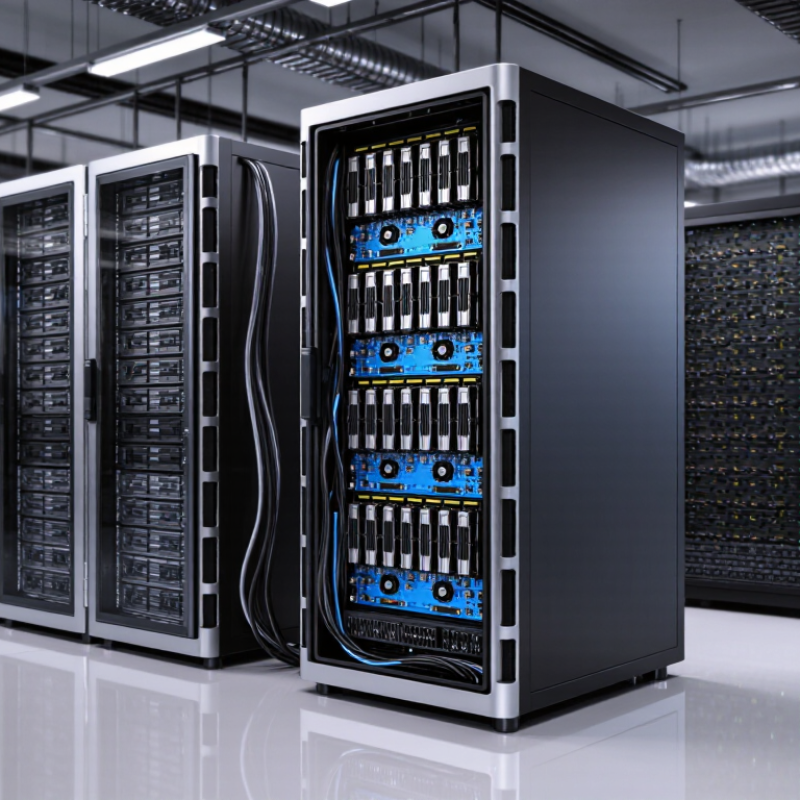
China’s AI training server market entered 2023 amid rising demand for systems that could handle larger models and heavier workloads. Buyers looked beyond processor counts. High-speed networking, memory capacity, and stable power delivery mattered too. In a busy data center, a rack’s heat output could quickly become a practical constraint. Cooling plans were no longer an afterthought.
By 2027, demand is likely to grow as enterprises, research teams, and cloud operators expand AI training. The pace will depend on more than model development. Access to advanced components, project budgets, electricity supply, and data-center construction can all shape purchasing decisions. Some organizations may favor dense, high-performance clusters; others may choose smaller deployments that are easier to cool and maintain. Growth, then, will not look identical across the market.
Forecasts deserve caution. Public estimates use different definitions of an AI server, so headline numbers may not be directly comparable. A procurement team should examine workload needs, network performance, service support, and power costs—not just peak computing figures. It is tempting to treat 2027 as a straight-line extension of 2023. It probably isn’t. Delays and uneven demand could change the picture.
China’s leading AI server manufacturers span large-scale infrastructure groups, enterprise hardware specialists, and suppliers with deep data-center experience. Their systems may support model training with multiple accelerators, high-speed networking, and direct liquid cooling. Yet product names matter less than verified performance under your workload. Ask for benchmark results using your model, dataset, and precision settings. Check accelerator availability, memory capacity, power draw, and service coverage before comparing prices.
Real deployments reveal details that glossy specifications often miss. A dense rack can require stronger floor support, careful airflow planning, and upgraded power distribution. Network bottlenecks may slow training even when processors remain underused. Request a clear bill of materials and confirm which components are locally supported. A comparison table can still hide inconvenient details. I would also verify replacement-part lead times, since published service targets may not reflect every region.
Tips: Test a pilot rack with representative jobs. Record throughput, heat, and failure recovery. Ask for cooling and power estimates in writing. Leave room for growth; early capacity plans are often too optimistic.
Best AI Training Server Manufacturers in China
An AI training server built around an 80 GB HBM3 accelerator can hold larger model segments close to the compute cores. That matters when training workloads repeatedly move weights and activations. High memory capacity helps, but it does not remove every bottleneck. Cooling, power delivery, and interconnect design still shape real performance.
The 3.96 PFLOPS FP8 figure is a peak benchmark, not a guaranteed training speed. It assumes specific operating conditions and may include structured sparsity; results vary with software, model architecture, and server configuration. Ask manufacturers for measured results using your workload, including throughput, power draw, and sustained temperatures. A short demonstration is useful. A long run is better. Check whether multiple accelerators communicate efficiently, since slow data transfer can leave expensive hardware waiting. I would also verify service coverage and component availability; published specifications rarely tell the whole story.
Tips: Request a full-system test with your model and batch size. Record tokens per second, memory use, and temperatures after several hours. If the vendor cannot share reproducible test conditions, treat the headline number cautiously.
Best AI Training Server Manufacturers in China
Server Architecture Comparison: GPU Scale, NVLink, and 400 Gb/s Networking
When comparing AI training servers, look beyond the number of GPUs. A tightly coupled server uses NVLink to move data between GPUs, helping large models exchange parameters quickly. Across servers, 400 Gb/s Ethernet offers up to 50 GB/s of raw bandwidth per link, before protocol overhead. That distinction matters: GPU-to-GPU traffic inside one chassis is not the same as traffic crossing the network. Check GPU count, link topology, and network ports together.
Scale has a cost. The International Energy Agency’s Electricity 2024 report estimates data centres used about 460 TWh of electricity in 2022, with demand potentially exceeding 1,000 TWh by 2026. Compare power draw, cooling design, and measured training performance—not just peak specifications. MLPerf Training results provide standardized workload comparisons, but results can vary with software, tuning, and system configuration. One detail is easy to miss: a fast link cannot fix poor data-loading performance.
Tips: Ask for a node diagram and sustained workload results. Confirm whether 400 Gb/s ports are dedicated to each node or shared. Check cooling under full load. Small print matters.
Illustrative, vendor-neutral node configurations. GPU interconnects such as NVLink connect accelerators within a node; 400 Gb/s network ports provide scale-out connectivity between nodes.
Each 400 Gb/s port has a theoretical line rate of 50 GB/s per direction before protocol overhead. Actual GPU counts, interconnect topology, and network configurations vary by system.
Best AI Training Server Manufacturers in China
When evaluating Chinese AI training server manufacturers, procurement teams should measure usable compute, not chassis specifications alone. Ask for rack-level power density in kilowatts, including networking, storage, and cooling overhead. A 30 kW rack may require rear-door heat exchangers or direct liquid cooling. Request thermal test records at sustained load, not short benchmark bursts. This detail reveals whether the data center can support real training cycles.
PUE should be verified at the facility level, across seasonal operating conditions. A quoted design PUE can differ from the measured summer result. Require monthly readings, meter boundaries, and the calculation method in procurement documents. Compliance evidence should cover electrical safety, electromagnetic compatibility, cybersecurity controls, and export documentation where applicable. Ask for traceable certificates and version-controlled firmware records. Do not accept vague “international standards” language.
Technical support deserves measurable terms. Specify remote response times, spare-part locations, escalation paths, and on-site repair coverage. A practical service agreement should define replacement targets for power supplies, fans, and liquid-cooling components. Interview reference users operating comparable clusters. Their maintenance logs often reveal more than sales presentations. Some manufacturers may offer impressive density but lack commissioning discipline. That weakness is easy to underestimate. Field experience shows deployment plans can fail when cable paths and water quality are reviewed too late. A pilot rack and witnessed acceptance test can expose these assumptions before full installation.
Buyers needed systems for larger models and heavier workloads. Processor counts alone were not enough.
Enterprises, research teams, and cloud operators may expand AI training. Growth may remain uneven. Budgets, component access, electricity, and construction schedules will influence purchases.
Probably not. Delays, power limits, and uneven projects could change the market. A straight-line forecast may be too optimistic.
Check memory capacity, network speed, cooling, and sustained performance. A server with more GPUs may not train faster in practice.
Internal links move data between GPUs inside one chassis. Network connections move data across separate servers. They solve different problems.
It offers up to 50 GB/s of raw bandwidth per link. Protocol overhead reduces usable throughput. Ask whether ports are dedicated or shared.
Dense systems produce substantial heat under full workloads. Cooling can become a rack-level constraint. Power costs also affect long-term operating budgets.
Request a node diagram and sustained workload results. Confirm GPU topology, memory, network allocation, and cooling behavior. Small details matter.
No. Slow data loading can still limit performance. This comparison is imperfect, and real workloads deserve testing.
China’s AI training server market is expanding rapidly, supported by rising demand for large language models, computer vision, scientific computing, and enterprise AI applications. This article examines market demand in 2023 and the growth outlook toward 2027, while explaining how a capable ai training server manufacturer can address increasing requirements for compute capacity, scalability, energy efficiency, and reliable service. It also outlines key server design considerations, including GPU quantity, high-speed interconnects, memory bandwidth, and 400 Gb/s networking for distributed training.
The discussion uses the NVIDIA H100 as a performance reference, highlighting its 80 GB HBM3 memory and up to 3.96 PFLOPS FP8 capability. For procurement teams, important evaluation factors include power density, data-center PUE, regulatory compliance, system stability, deployment flexibility, warranty coverage, and technical support. Together, these criteria provide a practical framework for comparing AI training platforms and selecting infrastructure that can support both current workloads and future expansion.

Vertex AI Server